“This trade is an old worldly trade and its beauty lays in the time and patience it takes to create by hand…bespoke unique instruments which not only have to look but to sound beautiful and last several life times.” Ilja Grawert 2022
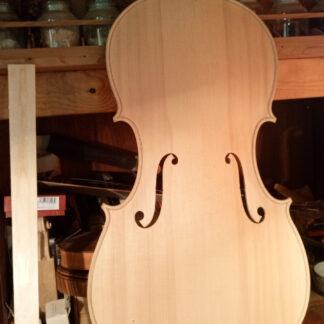
For the last seven days I have been working firstly correcting the outside arching of the 7/8 size studio cello changing all around the f-holes and in the middle of the top. Then I was removing lots of material from the inside of the top plate with the little thumb planes preparing the plate for the fine tuning so the cello will sound beautiful. Go down to video
Next will the fine-tuning of the top plate start and the bass bar. There will be another update for that.
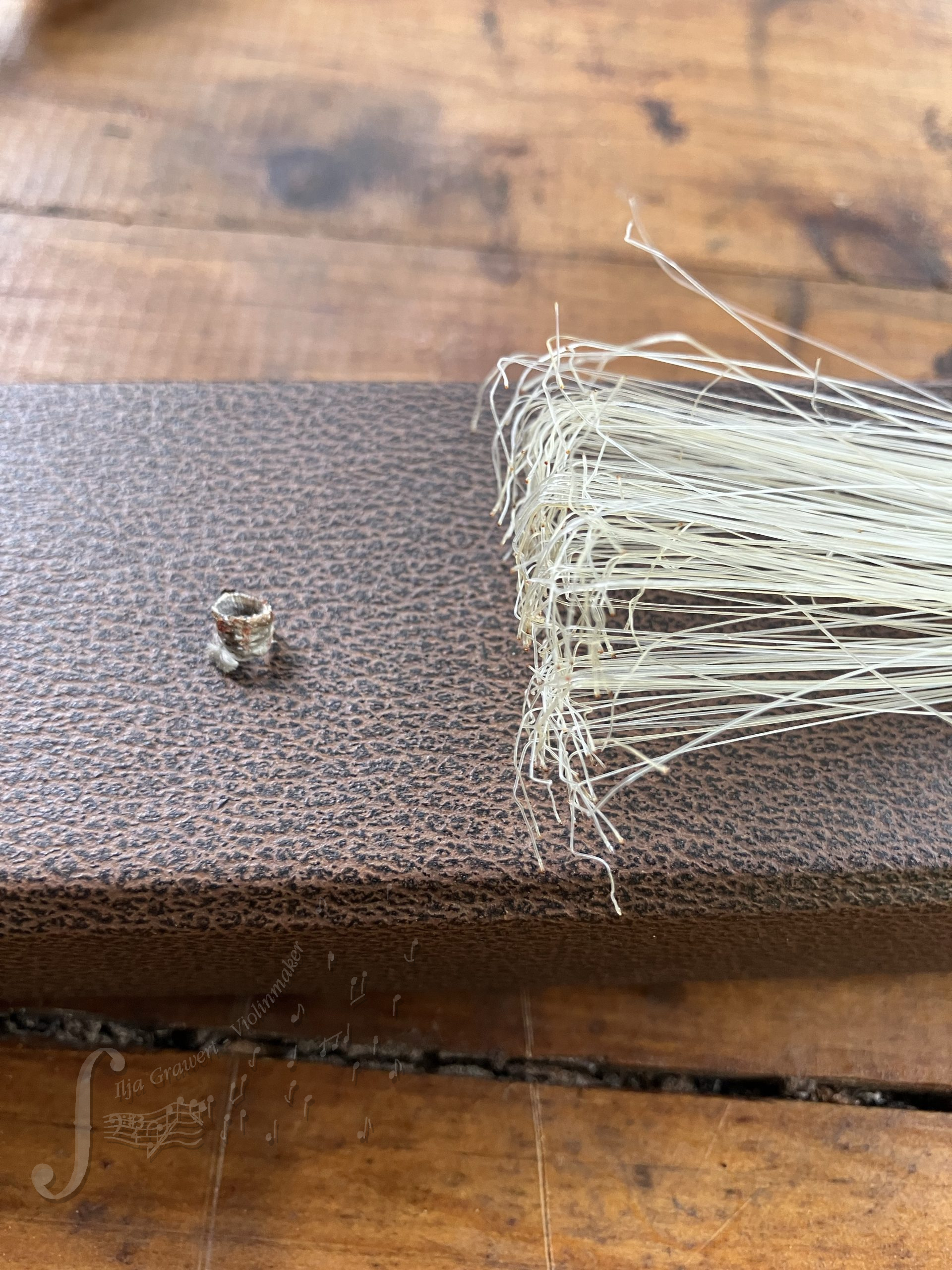
Recently I received a bow for rehair where it was said that the bow has mites. Mites are definitely a bad cause for loosing bow hair as you have to clear the case and all other cloth items including the cloth around the rosin of those little animals.
However it turned out that the cause wasn’t mites at all but either a bad knot in the tip of the bow or the bad habit of the musician of pulling a broken hair instead of cutting it with scissors (or even a combination of both)
When you pull hair out of the tip you pull it out of the knot and then makes the knot looser, soon more and more hair will fall out until there is hardly any left.
Hair coming out of a loose knot The ends clearly showing that the hairs fell out of the knot After I pulled all the hair out of the knot The hair in its entirety
Currently as a little side hobby I learning to stamps on wood. So far I am getting closer to acceptable quality with every new attempt. When I am happy there will be new, traditional stamped labels in my violins. beautiful look and no printing involved…very traditional old craft, old time. Stamp No1 was the first trial ever in rubber and is just not good enough, and No2 is done in a soft rubber and a little bit better but triggered a material change and Stamp No3 is my first trial in end grain hardwood. I am still improving the method and am already getting better results.
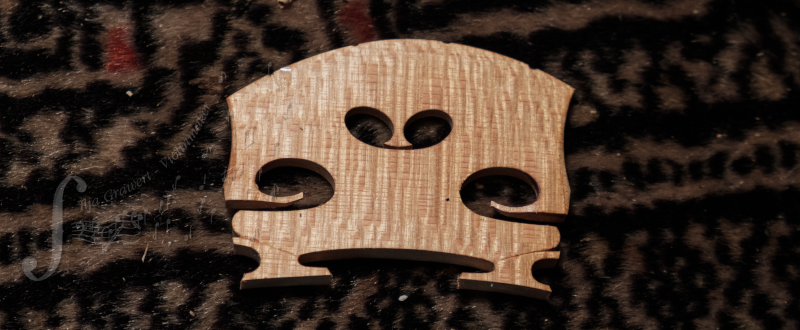
I was just cutting a bridge for one of my own older, fully handmade by me, violins. Using the best bridge timber, which is now a minimum of 40-50 years old. The finished bridge is promising to be of the highest sound quality. I am very much looking forward to hearing this violin again after a good service.
very old bridge timber in my workshop at Ilja Grawert – Violinmaker
In 1982 the wood of these bridge blanks was already well seasoned and cost around $7. If I would have invested the same money in gold or houses I would now roughly end up with a return of 400-500% valued at $28-35, which is equal to the inflation rate from 1982 until now.
However over time gold, houses and most other investments are not improving in quality the same way that violin timber does. This is why most of the violin wood saw mills in Germany raise the price of older wood by 10% per year of storage, which means the accumulative price doubles every 7 years. Looking at a price of $7 for this bridge blank in 1982, it would be 7.70 in 1983, 8.47 in 1984, $9.317 in 1985 and so on and just under double by the year 1989. In 1989 I would pay $14, in 1996-$28, 2003-$52, 2010-$104, 2017-$208 and by next year, 2024 I would be paying $416 for the same piece of timber for which I paid $7 forty two years ago. Can you imagine paying around $400 for the same bridge blank, the small piece of well seasoned maple in the right of the photo, and this is only the wholesale price.
The bridge on the left beside the blank is fully cut and ready to be used on this beautiful violin. When all the work is done, including putting strings on and adjusting the sound, it will have taken anywhere between 3 and 4 hours of my personal labour. I would end up at a very high price for one of those bridges.
This brings me right back to why I am doing this beautiful work… sure it is for money to live and support my family… but it is more for the love of beautiful violins, violas, cellos and basses and the love of good music played on well serviced instruments. Even after 40 years of working as a violin maker as my only source of income I still get excited with every instrument on my workbench to create the most beautiful sound it is capable of.
This also applies to professional musicians who never get paid for the years of hard work, often from as young as 5 years of age, with daily practice, often for hours after school.
I own a substantial amount of violin, viola and cello wood which I purchased in Germany between 1982 and 1994 relatively fresh (5-10years seasoned) for anywhere between 150-500 for a set to make one violin. Imagine the value of a hand made violin adding 160-240 hours of labour.
Ilja Grawert violinmaker and son playing the fully handmade violin in his North Queensland and Brisbane workshop
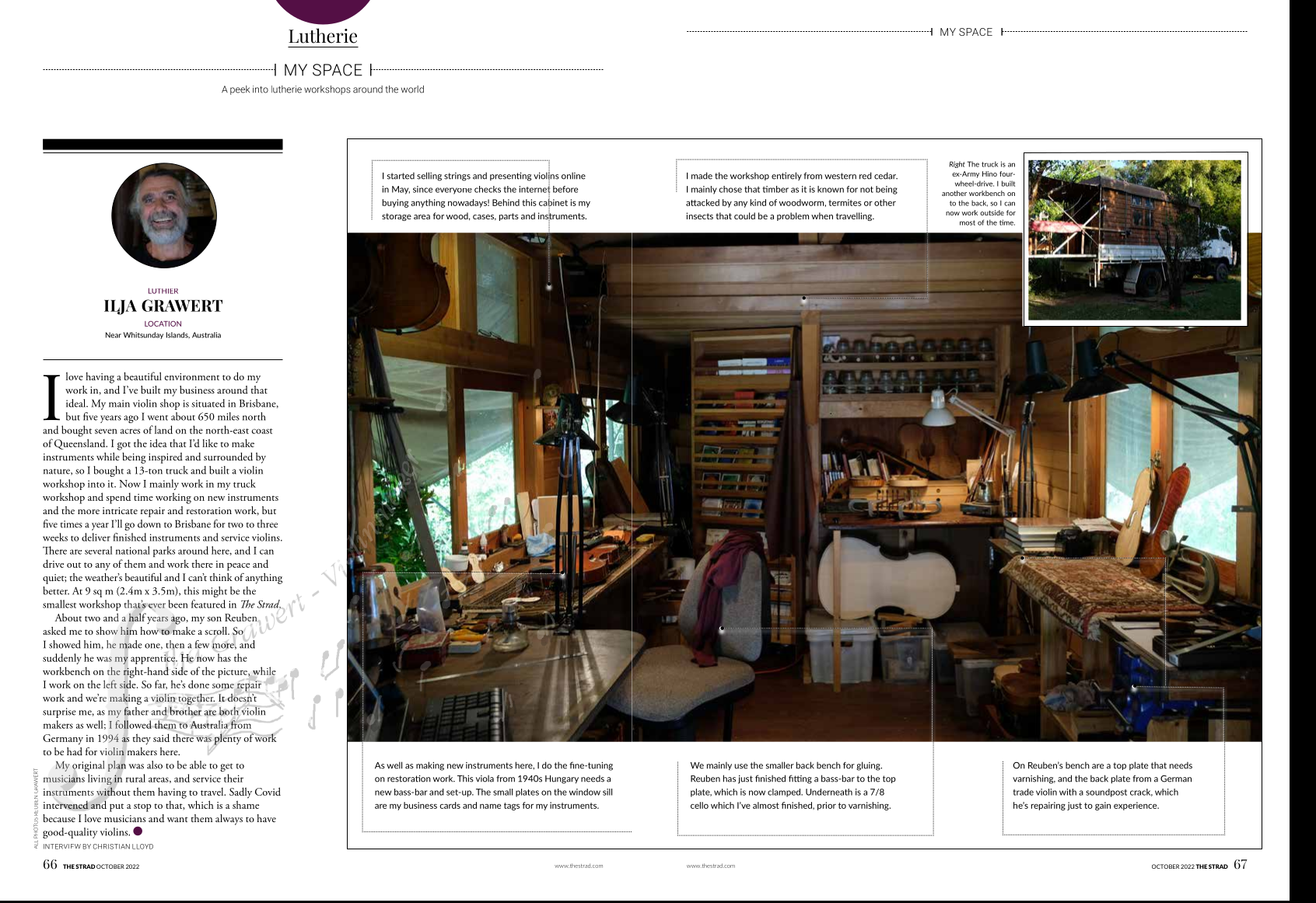
You cannot imagine my joy when I walked into the local post office today, where I am well known and was greeted by: “Guess what is in your Po Box…” After month and month of waiting for the October issue of The Strad magazine, I think maybe 15 emails to the publisher, as well as driving everyone crazy with my daily question about those magazines, I am happy to finally see this article in print…
Ilja Grawert violins in Brisbane Australia The Gap and North QueenslandAn here the cleaned up readable version
After the full size studio cello was varnished and set-up it still needed some fine adjustments, a lot of playing and figuring out which are the best strings to support its beautiful sound. Now after two extra month of fine tuning the cello it is a very vibrant, ringing but warm and deep sounding cello. I am very happy with it. It is time to change it from the pre-order price to the full price. Call or email me for playing this cello let it be for purchase or only to have a play.
After spending the last few month building the two studio cellos and the studio 15 1/2″ viola, and restoring two more old German ~1920s viola and old Hungarian/German ~ 1950s viola, all are now set-up and ready to be played. I am extremely happy with the sound of all 5 instruments. The cellos are very different, The full size cello has a very full warm and beautiful tone, speaks easy. The 7/8 cello has a more powerful outgoing tone with still a lot of beauty. All three violas have a deep very even sound speak easy and have beautiful but strong A strings. The cellos are already in my web-shop. The violas will be online presented in about 3 weeks time as my son Reuben usually takes the much better photos. He is not here in Brisbane with me but he is keeping the North Queensland workshop open. If you have interest in more information about the violas or cellos ….please email me to contact@grawert.com.au or sms to 0437 88 2468
This will make space for my next project a 3/4 studio violin, finishing a fully handmade violin on order, as well as finally developing the extra large violin for the viola player so it doesn’t feel so small and some other surprises.
Then obviously there are a lot of smaller or larger repairs and restorations which belong to customers and I will not publish.
Obviously I have my favorites out of these five… but do not like to publish here.
7/8 studio cello with fleur de lis at Ilja Grawert violin shop workshop Brisbane AustraliaGerman viola around 1920 at Ilja Grawert violin shop workshop Brisbane AustraliaHungarian/German viola around 1950 at Ilja Grawert violin shop workshop Brisbane Australia4/4 studio cello with fleur de lis at Ilja Grawert violin shop workshop Brisbane Australiatwo studio cellos at Ilja Grawert violin shop workshop Brisbane Australia
To get a little inside of what I have been working on in my North Queensland workshop in the last few month, visit my current projects page and see some of the steps in the building of two of my studio cellos, 7/8 & 4/4 size and a 15 ½” viola. They will be finished and ready to be viewed in my The Gap workshop when I come down for a brief period to do repairs, set-ups and instrument services after the 20th of September in about 1-2 weeks time. https://www.grawert.com.au/…/workshop…/current-projects/ #cello#violinmaker#Brisbaneviolinshop#cellomaker#studiocello#fleurdelis#cellos#violoncello#onlyattheviolinmaker#luthier
After the top plate was finished, glued to the sides…the back finished and fine-tuned …the body closed… the varnishing started. The varnishing process is now nearly finished. I wanted to create a dark brown, classic old looking colour this time…with the ‘Fleur De Lis’ shining through the many layers of varnish. What do you think of this colour?
Each cello carries a song of its own, telling a story of its proportions, the tools and the hands shaping it from a block of wood into this beautiful creation of sound.